Inflation Is Complicated

What is inflation? It can be described as an increase in average prices or the cost of living. What causes inflation? One popular definition is too much money chasing too few goods. If you ever meet anyone who says he has too much money, let me know.
There are said to be different types of inflation.
Built-in inflation is also known as the wage-price spiral – workers demand higher pay, and this results in higher prices.
Cost push inflation is where the cost of especially goods rises because of circumstances. The world runs on energy, and if there are difficulties in supplying that energy, prices will rise across the board. If there is a particularly bad harvest or if there is a shortage of staple foods, again, prices will rise.
Then there is demand push inflation, that is easy to understand. If there is a heavy demand for goods, the price will rise. This is not all bad news though, because if the demand is particularly high, more companies will enter the market, and the price will fall. If the demand for something is extremely high, this can lead to economies of scale. In this connection, the reader is invited to compare the production of tinned food today with its genesis.
Another observation that may be made about inflation is that it is a personal thing. People who neither smoke nor drink alcohol are affected less by rising prices far less than those who do either or both.
Let us though consider another reason for inflation. In 1980, a first class stamp cost 12p. In 1990 it was 22p. In 2000, it was 60p. Today, it is a staggering £1.80, and sending a large letter can cost you £3.60. On the face of it, this is outrageous, compare this with an 800 gramme loaf of bread, average price in 1980 around 33-35p. Today, the average price of a loaf is 74p. True, there are brands that cost a lot more, but the percentage rise is a lot less than for stamps. There is a major caveat here though, that is that for every letter we send, most people send a dozen, a hundred or a thousand e-mails which can cost...absolutely nothing.
If you are content to use a free e-mail account and log on from your local library, sending an e-mail is totally free. If as is more likely you own a desktop or a laptop, true, that is still a fair sized investment, and you have your ISP to pay every month, but when you factor in all the other things you use your computer for, including work, the cost of sending an e-mail is negligible. Which brings us to technology.
If you read the linked article above about tinned food, you would have learned that at the very beginning, a skilled craftsman could seal about six cans per hour. Millions are now produced in Britain alone every day, and this is possible because of automation, in other words, technology. Advances in food technology have been very impressive over the past couple of hundred years, but they are dwarfed by advances in computer technology over the past half century – see the illustration below.
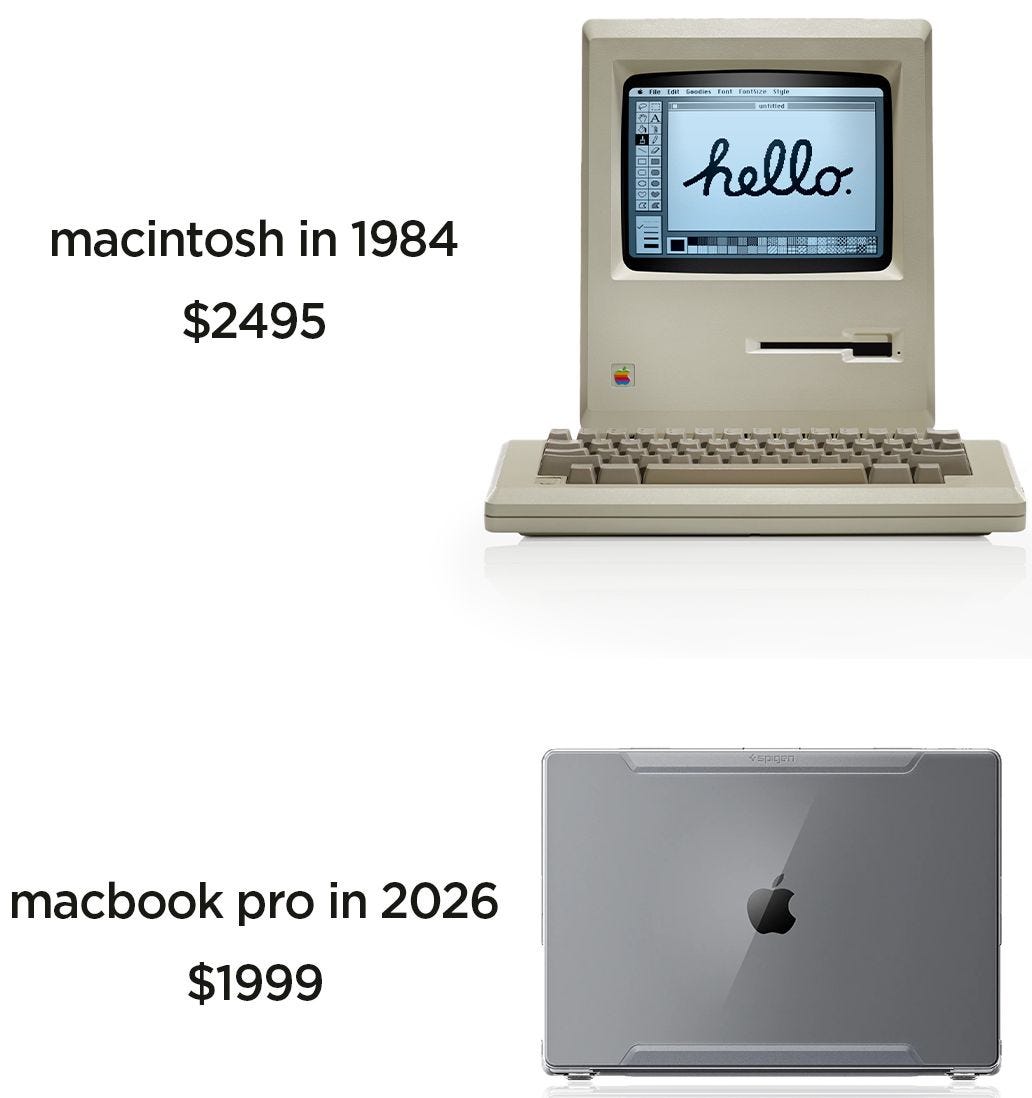
It is technology in all its myriad forms we should look to in order to bring down the cost of goods and services for everyone. The latest advance is of course Artificial Intelligence. If we can harness that properly, we can make inflation a thing of the past. And poverty. We have the power to do it, now all we need is the will, and that begins first and foremost with the liberation of the financial system.